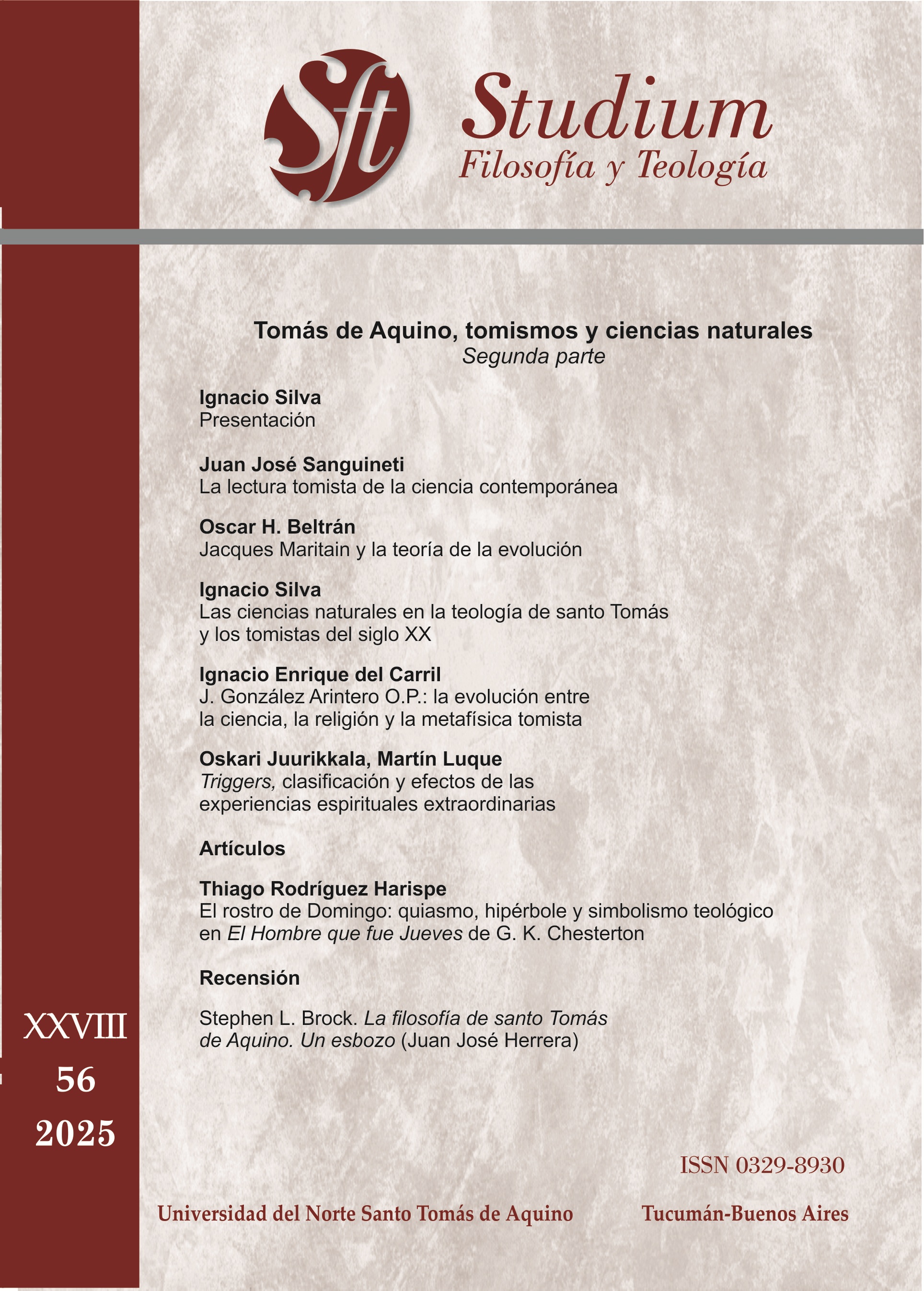
J. González Arintero O.P.: Evolution between Science, Religion and Thomistic Metaphysics
DOI:
https://doi.org/10.53439/stdfyt56.28.2025.313-331Keywords:
Neothomism, Gonzalez Arintero, evolution, metaphysics, ontological and organic speciesAbstract
At the end of the 19th century, Pope Leo XIII promoted Thomistic studies within the Catholic Church. Father Juan González Arintero was a faithful representative of the Neo-Thomism of that era. In 1880, he was sent to Salamanca to study physico-chemistry. In an environment hostile to the faith, the young friar studied the theory of evolution in depth and, contrary to expectations, became increasingly convinced of its validity. This new conviction compelled him to compatibility between the theory and not only Catholic dogma but also Thomistic metaphysics. Thus, he set out to attempt a synthesis of science, philosophy and religion from a Thomistic perspective, responding to his opponents on the right (the intransigents) and on the left (pseudo-science) regarding what should be the proper criterion for the relationship between science and religion. Arintero achieves this synthesis between evolution and Thomistic metaphysics through the distinction between organic species and ontological species. Beyond the critiques that could be made of his proposal, it undoubtedly demonstrates the true spirit of openness the Church had toward science.
Downloads
References
Alba Sánchez, R. (2006). La evolución de las especies según Juan González Arintero. Facultad Eclesiástica de Filosofía. Universidad de Navarra.
Artigas, M., Glick, T. F. y Martínez, R. A. (2010). Seis católicos evolucionistas. El Vaticano frente a la evolución (1877-1902). B.A.C.
González Arintero, J. T. (1898). La evolución y la filosofía cristiana. Librería de Gregorio del Amo.
González Arintero, J. T. (1901). El Hexámeron y la ciencia moderna. José Manuel de la Cuesta.
González Arintero, J. T. (1903). Teleología y teofobia (2° parte de La providencia y la evolución). Cuesta.
Haeckel, E. (1887). The History of Creation (Vol. I, R. Lankester, trad.). D. Appleton & Co.
Haeckel, E. (1893). El monismo como nexo entre la religión y la ciencia. Profesión de fe de un naturista (A. Machado Núñez, ed. y M. Pino G., trad.) Madrid.
Haeckel, E. (1904). The Wonders of Life. A Popular Study of Biological Philosophy. (J. McCabe, trad.) Watts & Co. https://archive.org/details/in.ernet.dli.2015.22567/page/n9/mode/2up
Haeckel, E. (2020). The Riddle of the Universe at the close of the Nineteenth Century (1ra. ed., J. McCabe, trad.). Pantianos Classics.
León XIII. (1879). Aeterni Patris [Epístola encíclica]. https://www.vatican.va/content/leo-xiii/es/encyclicals/documents/hf_l-xiii_enc_04081879_aeterni-patris.html
Pérez Casado, Á. (2014). El amor vive creciendo. Introducción a la vida y pensamiento de Juan González Arintero. San Esteban.
Thomas Aquinas. (2019). Sancti Thomae de Aquino Responsio de 43 articulis ad magistrum Ioannem de Vercellis (E. Alarcón, ed.). Corpus Thomisticum. https://www.corpusthomisticum.org/os3.html
Zanotti, G. J. (2011). Filosofía de la ciencia y realismo: los límites del método. Civilizar, 11(21), 99-118. https://doi.org/10.22518/16578953.37